Tree removal sits at the intersection of safety, property value, and good stewardship of a landscape. Most homeowners would rather keep mature trees, and often that is the right choice. But there are times when the safest, most responsible decision is to take a tree down and reset the site for the long term. Knowing how to evaluate a hazardous tree, what a professional crew actually does, and how to navigate permits, pricing, and cleanup will save you money and headaches. It can also prevent injuries. After two decades of walking yards with homeowners, I have learned that clarity up front is the best insurance policy.
When removal is the right call
A healthy tree provides shade, stormwater control, wildlife habitat, and curb appeal. Removing one is a last resort. Still, I have recommended removal many times, often after storms, root failures, or advanced decay. You do not need to be an arborist to spot red flags.
Consider removal if you can honestly check several of the following.
- The tree has large dead limbs over targets like the roof, driveway, or play area, and pruning would disfigure what is left. You can see a cavity or decay at the base, mushrooms at the root flare, or a pronounced lean that worsened after recent storms. Major roots were cut for utilities, a new driveway, or foundation work within the past three to five years. The trunk splits into two or more co-dominant stems with visible cracks, and a cabling system would not compensate for the defect. The species is failing across the site, for example dead ash after emerald ash borer, and you see thin canopy, heavy woodpecker activity, and bark sloughing.
An ISA Certified Arborist should always confirm the diagnosis. I have visited properties where a tree written off as “dying” only needed corrective pruning and a soil fix. A second opinion can swing the decision.
How a professional evaluates a risky tree
Arborists look at four things in sequence. First, the defect. That might be decay, root plate failure, co-dominant leaders, or storm damage. Second, the likelihood the defect will cause part of the tree to break or the whole stem to fail. Third, the targets in range, which can include roofs, service drops, parking areas, and public sidewalks. Fourth, the consequences, from dented gutters to life safety risks.
Expect your arborist to use a sounding mallet, a probe, or a resistograph for suspected decay. On large removals I often recommend a Level 3 assessment with advanced tools, especially when a crane must be set near the tree. For roots, we watch soil heaving and gaps opening opposite the lean. If a tree has shifted and the soil has cracked at the base, take that seriously. In saturated Ohio clay, once a root plate lets go, it rarely restabilizes.
Species matters. Cottonwood, willow, and silver maple shed limbs more readily than white oak, beech, or tulip poplar. Height and crown spread matter too. A 70 foot tree with a 60 foot sail of branches has a very different risk profile than a 30 foot ornamental with a compact head.
Permits, utilities, and neighbor boundaries
Rules vary by municipality. Many cities require permits for street trees planted in the right of way, and some regulate removals of large or “heritage” trees on private property. Check with your local forestry office or planning department. If you are in Summit County or the Akron area, a quick call to the city service center will confirm whether a permit is needed for your specific address and tree location.
Before any digging or stump work, contact Ohio 811 for utility locating. It is a free call that avoids very expensive mistakes. Even if the removal itself does not require excavation, stump grinding can intersect shallow gas lines, low voltage lighting, irrigation, or communication lines.
If a trunk straddles a property line or a canopy overhangs a neighbor’s garage, discuss the plan in writing. Boundary trees can be jointly owned under Ohio law, which affects permission and cost sharing. Good fences make good neighbors, but good notes help even more.
What removal really costs and why
Homeowners ask for a single number, but tree removal pricing depends on size, access, risk, complexity, volume of wood, and cleanup scope. A small ornamental in open lawn with easy truck access might cost a few hundred dollars. A 70 foot oak over a roof with no machine access could run into the several thousands, particularly if a crane and traffic control are required.
Typical ranges I have seen across the Midwest:
- Small removals under 20 feet, $200 to $600, depending on cleanup. Mid size trees 20 to 50 feet, $600 to $2,000. Large trees 50 to 80 feet, $1,500 to $5,000. Extra large or high risk removals with crane work, $3,000 to $8,000 or more.
Stump grinding is usually priced by diameter at the widest point, measured at the soil line. Expect something like $3 to $7 per inch with a minimum service fee that often falls between $150 and $250. If the stump is near a wall, fence, or steps, add a little for the extra time and cutter tooth wear. Full stump excavation that removes major roots costs more than grinding and disrupts soil more severely, but it clears the site for footers or new hardscape.
Storm damage cleanup typically carries a premium. Crews work under tensioned wood, broken hangers, and unstable ground. Emergency callouts at night or in active weather add to labor and insurance costs. Many reputable providers in Northeast Ohio, including tree service Akron companies, publish transparent hourly rates for storm work during declared emergencies. Ask for them up front.
Picking the right tree service, Akron and beyond
Price matters, but it should not outrun safety and credentials. If you are talking with a tree service in Akron or any surrounding township, vet them with the same rigor you would use for a contractor in your kitchen.
Ask to see a certificate of insurance sent directly from the agency, not a photocopy. You want general liability that specifically includes tree work, and workers’ compensation for everyone on site. Confirm an ISA Certified Arborist is on staff, ideally the person writing your plan. TCIA Accreditation is a plus because it audits safety, training, and business practices.
An estimate should spell out the work: complete removal down to a flush cut, stump grinding to a specified depth, disposal of wood and chips, turf protection, and any crane or street closures. I also like to see how they will access the site, which equipment they plan to bring, and the expected duration. Low bids often omit critical steps, like raking out chips or repairing ruts.
A final note on marketing buzzwords. You may see “stump griding” in online ads and directory listings. Assume they mean stump grinding. The quality difference has nothing to do with spelling, it comes from the operator’s care and the depth specified in the scope.
What a professional removal day looks like
Good removals look almost choreographed. Even on modest trees, seasoned crews move with a rhythm that keeps people and property safe.
- Walkthrough and setup. The crew leader reviews the plan, confirms utility locates, sets cones, and defines drop zones. Turf mats or plywood go down if heavy gear will cross the lawn. Access and tie in. A climber ascends with a primary line and a backup, or a spider lift or bucket truck is positioned if access allows. The ground team stages rigging lines and blocks. Piece by piece removal. Branches come off in manageable sections, lowered with friction devices if needed. Each cut is planned to keep weight under control and avoid swings. Trunk takedown. Once the canopy is off, the stem is either notched and felled in one direction or chunked down in short rounds with wedges and rigging. Cleanup and stump. Wood is loaded out, debris raked, and the stump is ground to the contracted depth. Chips are hauled or left per the agreement.
A competent crew will pause as conditions change. If a wind gust rises or the rigging behaves unpredictably, plan adjustments matter more than the clock.
Safety you should see on site
Tree work blends saws, heights, and unpredictable forces. It is unforgiving of shortcuts. Expect helmets with face shields, chainsaw chaps or pants, hearing protection, and eye protection for everyone within the work zone. Climbers should wear two points of attachment when cutting aloft. Ground workers should use saws with functioning chain brakes and bar lengths sized to the job, not oversized for show.
Rigging gear, from slings to blocks, must be rated for loads with safety factors built in. I wince when I see homeowners stand in a drop zone to “help” with a rope. A single barber chair or a swing under tension can break bones. If you are hiring professionals, give them space to work and stay behind barriers.
Special cases, from storm splits to utility tangles
Storm damage cleanup is a category of its own. Split codominant stems, hangers lodged in the canopy, and partially uprooted trees carry stored energy. Cuts can release that energy violently. After the 2019 line of storms that marched across Summit County, I spent three weeks removing broken tops from red oaks. We used taglines to control movement and always cut from outside the path of release. That is not a job for a homeowner with a new saw.
Trees intertwined with service drops or primary lines require coordination. Most utilities will de-energize or drop service lines to a house during a scheduled window. Primary lines on poles are a different matter and may require utility crews on site. A reputable tree service Akron team will have those contacts and schedule the assist.
Dead ash, common in Northeast Ohio after emerald ash borer, deserve special caution. Dry ash fibers are brittle, so the tree will not “talk” through creaks before it lets go. I double tie in and keep pieces small on dead ash, even if it takes longer.
Leaning trees after weeks of rain may recover if the root plate is intact and the lean is minor, under 15 degrees, with no soil cracking on the compression side. Anything more serious, particularly with newly exposed roots and gaps opposite the lean, usually needs removal.
Stump options and what to expect under the mulch
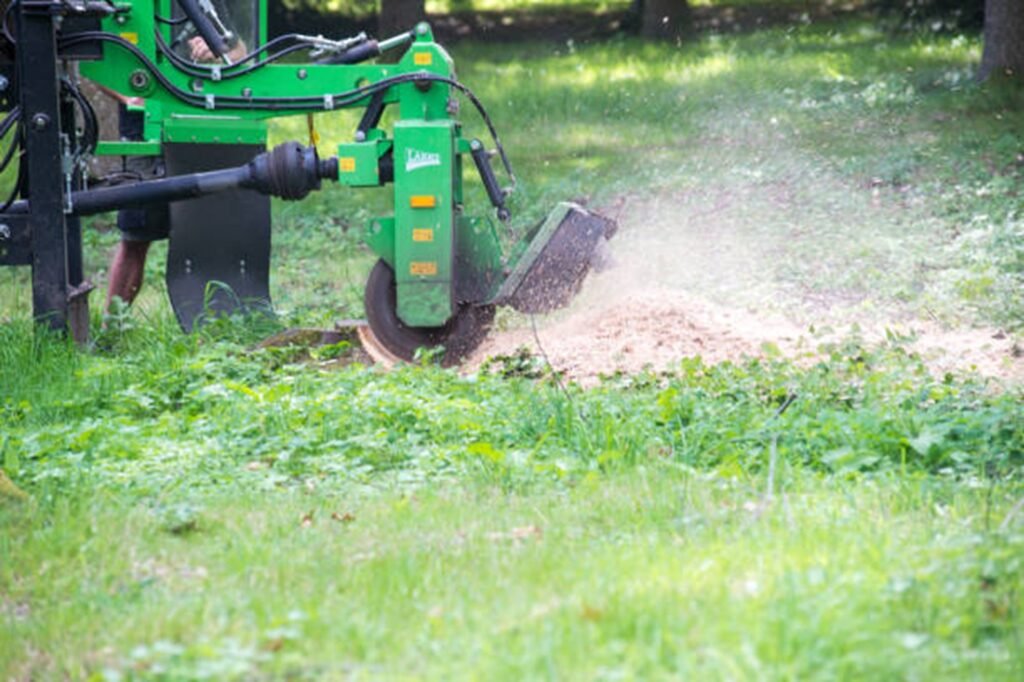
Homeowners often underestimate stumps. Left at grade, a stump invites suckers and pests, and it complicates mowing. Grinding is the most common solution. A small tracked grinder will chew the stump and large lateral roots down to a typical depth of 6 to 10 inches, sometimes 12 if you request it. That allows for topsoil and sod or mulch, but not for a new tree planted in the exact spot. For replanting within a few feet, we shift the new hole to avoid a tangle of wood chips and roots.
Grinding generates a surprising volume of chips, often more than a pickup load even for a medium stump. Decide in advance whether you want chips hauled away or left for garden paths. If you plan to plant turf, I recommend removing most of the chips, backfilling with native soil, and allowing the area to settle for a few weeks before final grading.
Full stump and root ball removal makes sense if you are pouring a slab or building a wall. It is messy, typically needs a small excavator, and leaves a large void that must be compacted properly. For almost all residential yards, grinding hits the sweet spot on cost, speed, and site impact.
If you search online, you will see the term stump grinding spelled correctly and sometimes as stump griding. Either way, ask for the target depth in inches and whether the contractor will chase visible surface roots.
Aftercare and replanting a better tree
Removing a tree is not the end of your landscape story. It is a chance to correct past mistakes with species choice and placement. In the Akron area, hardiness zones are generally around 6a. That broadens your options but does not excuse crowding a red maple under a service drop.
For shade, consider swamp white oak, Kentucky coffeetree, or tulip poplar in open lawns. For smaller spaces, serviceberry, hornbeam, or Japanese tree lilac fit under wires and stay in scale. Avoid replanting right against foundations or over buried utilities. Give large trees 20 to 30 feet from the house, medium trees 15 to 20 feet, and small ornamentals 8 to 12 feet, adjusting for mature crown spread.
If you removed a tree due to soil compaction or drainage issues, fix the site before planting. Core aeration, compost topdressing, and a light mulch ring can transform establishment success. Water deeply and infrequently in the first two growing seasons, about 10 gallons per week for a small tree, more for larger caliper stock, tuned to rainfall.
DIY or hire it out
A careful homeowner can prune small limbs from the ground or fell saplings in open space. Beyond that, you enter a world of physics, kickback, and reaction wood that does not forgive mistakes. Chainsaws send tens of thousands of people to emergency rooms every year in the United States. Add ladders, and the risk multiplies.
If you must tackle a small removal, wear full PPE, keep both feet on the ground, and maintain escape routes. Never cut above shoulder height. The moment you need to leave the ground, set ropes, or work near a line or structure, call a pro. It is not weakness. It is wisdom.
Working with insurance after a storm
Homeowners insurance policies often cover tree removal when a tree damages a covered structure, like a house or garage. Debris removal from the yard alone may be covered with a smaller allowance, sometimes a few hundred dollars per tree with a total cap. Policies vary. Document everything with photos and a written estimate that separates emergency stabilization from full removal and cleanup.
If a tree on a neighbor’s property falls onto your fence, your insurer may handle the claim under your policy and subrogate later. Again, this varies by carrier. What consistently helps is fast communication with your agent, clear invoices from your tree service, and a scope that distinguishes urgent hazard abatement from non urgent site work. Many reputable crews who offer storm damage cleanup understand claims and will provide the line items adjusters ask for.
When to schedule removal
Winter has advantages. Frozen ground protects turf, leaves are off, and sightlines are clearer. Busy spring seasons can mean longer wait times and higher demand. Summer removals are fine with the right plan, but heavy sap flow in some species will gum up saws and create sticky chips. In autumn, increased winds stress marginal trees and can accelerate minor defects.
Disease and pest timing matters. For oaks in regions with oak wilt pressure, avoid fresh cuts in the warmest months when beetles carry spores between trees. Ask your arborist about local timing. In Northeast Ohio, many crews avoid non essential oak pruning roughly late spring to mid summer. That is guidance, not law, and urgent hazard work takes priority any time of year.
Environmental considerations and the afterlife of a tree
Before cutting, look for active nests, dens, or protected species. Many birds are protected during nesting season. Crews can often delay a non urgent removal a few weeks to allow fledging, or they can time the work to minimize disturbance. Cavity trees that threaten nothing can sometimes be retrenched into wildlife snags rather than fully removed, provided they stand well away from targets.
On the material side, urban logs do not have to become mulch by default. If you have a straight section of hardwood, some mills and artisans will take it for slabs or turning stock. That takes planning for access and loading, and the presence of metal in urban trees can complicate milling, but it is worth exploring. I have salvaged walnut, oak, and even storm fallen cherry this way.
Wood chips are not waste. They are slow release mulch that builds soil structure, especially around perimeter plantings and paths. Keep chips off foundations and tree trunks, maintain a shallow layer, and your soil life will thank you.
Local notes and getting help
If you are searching for tree service Akron providers, you will find a spectrum, from solo climbers to fully staffed companies with cranes and bucket trucks. Match the provider to the job. Small ornamental removals and simple stump work can be efficient with a small crew. Large, technical removals over tree removal akron roofs or lines are faster and safer with a larger team and the right gear. When you request estimates for tree removal Akron wide, ask for references from recent clients with similar projects, not just general testimonials.
A well run company will also be candid about what they do not do. Some focus on removals, others pair pruning, plant health care, and storm damage cleanup. For complex properties, a full service firm that can carry you from risk assessment through stump grinding and replanting is often worth a small premium. One point of accountability simplifies life.
A practical path forward
Walk your property with fresh eyes after major storms and once each season. Note changes, especially new leans, dieback in the canopy, and soil cracks near the base. Photograph the same tree from the same angle a few times per year. Patterns appear in photos that our eyes miss day to day.
If you suspect a problem, invite a qualified arborist to evaluate and talk through options. Ask for a clear scope and a plan that respects your budget and goals. Keep safety non negotiable. Good removal work is steady, deliberate, and quiet in its confidence. The right tree service shows up with a plan, leaves with your yard intact, and gives you a smarter canvas for your next planting.